

You know the feeling. It’s Sunday afternoon and your phone is sitting there, silently reminding you that you should call Mom. Or Dad. Or both.
You want to call. You really do. But somewhere between the guilt of not calling sooner and the quiet dread of another conversation that fizzles after five minutes, you keep putting it off. You check your email instead. Fold some laundry. Tell yourself you’ll call after dinner.
And then it’s Monday.
If this sounds like you, you’re not alone. Millions of adult children navigate the same awkward dance every week — wanting connection but struggling to find the words when the phone finally rings. The good news? That short, “boring” phone call is doing far more than you think. And with a few small shifts, it can become something both of you actually look forward to.
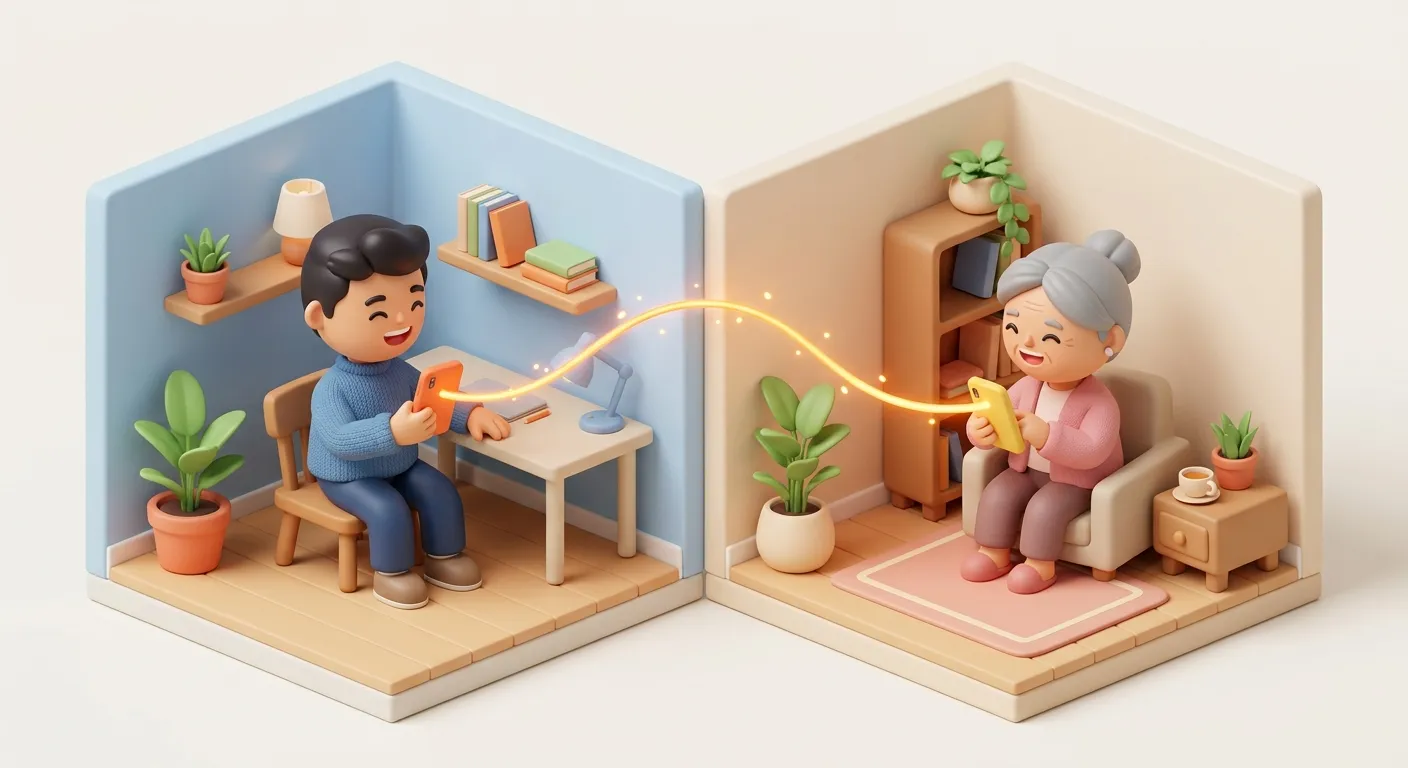
Why That Weekly Phone Call Matters More Than You Think
Here’s what the research says: regular social connection is one of the strongest predictors of cognitive health in older adults. A study published in the Journal of the American Geriatrics Society found that seniors who had regular, meaningful social interactions experienced significantly slower rates of cognitive decline compared to those who were more isolated.
And it doesn’t have to be a deep, soul-baring conversation. The ordinary stuff — what they had for lunch, the neighbor’s new dog, whether it rained — actually does the heavy lifting. These low-stakes exchanges keep the brain engaged in real-time processing: listening, responding, recalling details, reading tone.
For your parent, that 10-minute call is exercise for the brain. For you, it’s a thread of connection that compounds over time, even when individual calls feel uneventful.
The Guilt and Awkwardness Nobody Talks About
Let’s be honest about what makes this hard.
There’s the guilt — you didn’t call last week, and the week before that you cut it short because the kids were screaming. Your parent said “it’s fine,” but you heard the pause before they said it.
There’s the awkwardness — you ask how they’re doing, they say “fine,” you say you’re fine too, and suddenly you’re both sitting in silence wondering what comes next.
There’s the performance — you edit out the stressful parts of your life because you don’t want them to worry. They edit out the lonely parts of theirs because they don’t want to be a burden. So you end up with two people performing “fine” at each other for eight minutes.
And then there’s the role reversal — the slow, disorienting shift from being the child who gets called to the adult who does the calling. The one who checks in. The one who listens for clues about whether something is wrong.
None of this is comfortable. All of it is normal.
The first step toward better phone calls isn’t finding the perfect conversation starter. It’s giving yourself permission to stop performing and start being honest — even if “honest” means saying, “I don’t really have any news, I just wanted to hear your voice.”

How Often Should You Call Your Aging Parents?
There’s no universal rule. What matters more than frequency is consistency.
A predictable call every Sunday at 2 PM gives your parent something to look forward to — and something to structure their week around. For many older adults, especially those living alone, that weekly anchor matters more than the content of the conversation itself.
Here are some general guidelines:
- Living independently, nearby: Once a week is usually enough, supplemented by visits
- Living independently, far away: Two to three times a week helps you monitor wellbeing
- In assisted living: Weekly calls, plus a check-in with staff when needed
- Experiencing cognitive decline: Shorter, more frequent calls (even 5 minutes daily) tend to work better than one long weekly call
If your parent calls you multiple times a day, that’s worth paying attention to — it may signal loneliness, anxiety, or early cognitive changes. Rather than feeling frustrated, try redirecting the pattern by establishing a predictable call schedule.
30 Conversation Starters That Actually Work
Generic advice says “ask about their day.” But when your parent’s day involves a doctor’s appointment and a game show rerun, that well runs dry fast.
Instead, try these conversation starters organized by theme. Pick one or two per call — don’t turn it into an interrogation.
Memory Lane
- “What was your favorite thing to do on weekends when you were my age?”
- “Do you remember your first car? What was it like?”
- “What was your neighborhood like growing up?”
- “Tell me about your best friend when you were in school.”
- “What’s a meal Grandma (or your mom) used to make that nobody makes anymore?”
Daily Life
- “What’s been the best part of your week so far?”
- “Have you been watching anything good on TV?”
- “How’s the weather been there? Have you been able to get outside?”
- “What did you have for dinner last night?”
- “Have you talked to [sibling/friend/neighbor] recently?”
Opinions and Advice
- “I’m trying to decide between [two options] — what would you do?”
- “What’s the best piece of advice anyone ever gave you?”
- “What do you think about [current event that isn’t political]?”
- “If you could travel anywhere again, where would you go?”
- “What’s something you wish you had done differently at my age?”
Grandkid Updates
- “[Kid’s name] did the funniest thing this week — want to hear?”
- “[Kid’s name] has a [game/recital/event] coming up. I’ll send you pictures.”
- “[Kid’s name] was asking about you. They want to know [something specific].”
- “What do you think [kid’s name] should be for Halloween?”
- “[Kid’s name] is learning about [topic] in school. Did you learn about that growing up?”
Deeper Questions (When the Timing Feels Right)
- “What’s something you’re proud of that you don’t talk about much?”
- “Is there anything you’ve been wanting to do but haven’t gotten around to?”
- “What made you fall in love with Dad/Mom?”
- “What was the hardest thing you went through as a parent?”
- “What do you want our family to remember about you?”
Practical Check-Ins (Disguised as Conversation)
- “Have you been sleeping okay?”
- “Are you getting out of the house much these days?”
- “How’s your [knee/back/health issue] treating you?”
- “Do you need me to pick up anything next time I’m at the store?”
- “Is there anything around the house that’s been bugging you?”
If you want to go deeper, we’ve put together 50 questions to ask your grandparents before it’s too late — many of them work beautifully in a regular phone call.
When the Conversation Runs Dry
Silence doesn’t mean failure. Some of the most meaningful phone calls include comfortable pauses. But if the quiet feels heavy, here are a few rescue strategies:
Do something together. Watch the same TV show and call during it. Work on a crossword puzzle together over the phone. Flip through the same photo album if you both have copies.
Read to each other. A short article, a poem, a funny column from the newspaper. It takes the pressure off generating conversation and gives you something to react to together.
Share your screen. If your parent uses a tablet or smartphone, a video call where you scroll through photos together can fill 20 minutes effortlessly.
Send something ahead of time. A printed photo, a child’s drawing, a brief family update letter. When your parent has something physical to hold during the call, it gives both of you something concrete to talk about. Services like Hug Letters send a monthly printed family newspaper to grandparents, which many families find gives their phone calls a natural conversation anchor.
Lower the bar. A five-minute call where you both say “nothing much is new” but you hear each other’s voices? That counts. That matters.

Phone Call vs. Video Call: What Works Better?
It depends on the person.
Phone calls work well for parents who are:
- More comfortable with traditional technology
- Self-conscious about their appearance
- Hard of hearing (phone audio is often clearer than video)
- In assisted living with limited privacy
Video calls work well for parents who:
- Want to see grandkids in action
- Are visually oriented and engaged by seeing faces
- Can use a tablet propped up so they don’t have to hold anything
- Enjoy being “shown” things — your garden, the kids’ school project, the new house
For many families, the sweet spot is regular phone calls with occasional video calls for special moments — a birthday, a grandkid’s performance, or showing off a finished project.
If video calling is a struggle, check out our guide on sharing family photos with grandparents who don’t use technology for practical workarounds.
When Your Parent Tells the Same Story Again
This is one of the most common — and emotionally loaded — challenges of calling aging parents.
First, the reassurance: repetition doesn’t necessarily mean dementia. Older adults often retell stories for perfectly healthy reasons:
- The story matters to them. It’s a highlight, a defining moment, a piece of their identity they want to make sure you carry with you.
- They’ve run out of new material. When daily life is quiet, their archive of great stories becomes the richest source of conversation.
- Connection, not content. The retelling is really about wanting to share something meaningful with you. The story is the vehicle, not the destination.
The best response? Listen like you’re hearing it for the first time. Ask a follow-up question you haven’t asked before: “What did Grandpa say when that happened?” or “How old were you exactly?” You might be surprised — a familiar story can reveal new details when you ask new questions.
That said, if the repetition is frequent, comes with confusion, or is accompanied by other changes (difficulty with familiar tasks, trouble finding words, personality shifts), it’s worth noting and discussing with their doctor.
Red Flags to Listen for During Phone Calls
Your weekly call is also your early warning system. Over time, you develop a baseline for how your parent sounds — their energy, their vocabulary, their mood. Changes in that baseline can be meaningful.
Pay attention if you notice:
- Repeated confusion about dates, names, or recent events
- Unusual irritability or emotional flatness
- Less interest in things they usually care about
- Mentions of falls, missed meals, or forgotten medications
- The house sounding unusually quiet (TV always off, or always blaring)
- Reluctance to talk or abruptly ending calls
- New complaints about neighbors, staff, or friends that sound paranoid
You don’t need to interrogate. Just notice. Keep a brief log if it helps — even a note on your phone after each call. Patterns over weeks tell a more accurate story than any single conversation.
Getting Grandkids Involved
Multi-generational phone calls can be magical or chaotic, depending on the age and temperament of your kids.
Toddlers and preschoolers (2–5): Keep it short. Have them say hi, sing a song, or show a toy on video. Two minutes is a win.
School-age kids (6–11): Ask them to share one thing from their week. Some kids are natural phone talkers; others clam up. Don’t force it — but do make the opportunity consistent.
Tweens and teens (12+): This is where the relationship either deepens or fades. Encourage (but don’t mandate) independent calls or texts with grandparents. Even a once-a-month solo call between a teenager and a grandparent can build a bond that lasts.
For more on keeping that bridge strong as kids grow, read our piece on how to keep grandparents involved in every milestone.
When Your Parent Doesn’t Want to Talk
Sometimes the problem isn’t finding things to say — it’s that your parent shuts down.
This can happen for several reasons: depression, hearing loss that makes phone calls exhausting, frustration with cognitive changes they’re trying to hide, or simply being from a generation that doesn’t process emotions verbally.
Try these approaches:
- Shift the medium. Some parents who hate phone calls will happily exchange texts, emails, or handwritten letters.
- Send before you call. Mail a photo, a newspaper clipping, or a note. Then call and ask if they got it. Now you have a natural opening.
- Keep it short. “Just calling to say I love you. Talk soon.” Two minutes. No pressure.
- Visit if you can. Some parents are better in person, where body language fills the gaps that words can’t.
- Ask the staff. If your parent is in assisted living, their caregivers can give you insight into their mood and social engagement that your parent won’t share directly.
Don’t take it personally. And don’t stop calling.
Taking Care of Yourself, Too
Here’s the part nobody mentions in the “how to talk to your aging parents” articles: this is hard on you, too.
The weekly call can carry grief — for the parent they used to be, for the conversations you used to have, for the slow accumulation of changes you can’t stop. It can carry guilt, exhaustion, and a loneliness that’s hard to explain because the person you’re losing is still right there.
You are allowed to:
- Set boundaries. You don’t have to answer every call if your parent calls five times a day.
- Take breaks. Missing a week because you’re overwhelmed doesn’t make you a bad child.
- Feel multiple things at once. You can love your parent deeply and also dread the call. Both things are true.
- Ask for help. Siblings, other family members, community volunteers, and companion call services exist for a reason.
- Talk to someone. A therapist who understands caregiver stress can be a lifeline.
Making It Easier: A Simple Weekly Ritual
If you take one thing from this article, make it this: create a tiny ritual around your call.
- Pick a day and time. Put it in your calendar like a meeting.
- Prep one conversation starter. Just one. From the list above, from something that happened that week, from a photo on your phone.
- Call. Even if it’s only for five minutes.
- After you hang up, jot a quick note. What you talked about, how they sounded, anything you want to follow up on next time.
- Repeat.
That’s it. No elaborate system. No pressure to have a perfect conversation. Just show up, consistently, and let the connection compound.
Because twenty years from now, you won’t remember what you talked about on any given Sunday. But you’ll remember that you called. And so will they.

About Martin Gouy
Martin is the founder of Hug Letters. Hug Letters is a family newsletter for grandparents. Every month, grandparents receive a heartwarming newspaper with photos and stories from the whole family.