

Your daughter just lost her first tooth. It happened at dinner, in the chaos of a Tuesday night, and by the time you thought to call grandma, it was already 9 PM her time. You texted a photo instead. She sent back heart emojis.
That’s not nothing. But it’s not the same as grandma being the one who helped wiggle it free, or being there when the Tooth Fairy left her first dollar.
The milestones pile up. The first day of kindergarten. The school play. The little league game where he finally hit the ball. The science fair ribbon. The middle school graduation. Each one slips by, marked with a blurry photo in a group chat, a voice memo sent a day late, or a story retold on a Sunday call with half the details already faded.
This is one of the quiet losses of modern family life — and one nobody really talks about. The adult children carry the guilt. The grandparents carry the grief. And nobody has a good system.
This post is about building that system.
Why “I’ll Send Photos Later” Isn’t Enough
Here’s the honest truth about the gap between intention and reality: most families have a loose plan for keeping grandparents connected, and that plan quietly collapses under the weight of real life.
You mean to set up a standing video call. You mean to text more often. You fully intend to let grandma know about the recital so she can call right afterward. But the recital is on a Thursday, the kids need to eat, and by the time everyone is in bed you’ve forgotten.
The photo you send the next morning is sweet. But your parents missed the experience of anticipation — of waking up that Thursday and thinking about their grandchild taking the stage. They missed the chance to send a “good luck” text at 6 PM. They found out it happened instead of being part of it happening.
That distinction matters more than it sounds.
Research on grandparent wellbeing consistently shows that grandparents who feel informed and involved in their grandchildren’s lives — not just periodically updated — report better mental health, stronger sense of purpose, and closer family bonds. The mechanism isn’t just communication. It’s the feeling of being a witness to a life unfolding in real time.
So the question isn’t just “how do we share more photos?” It’s: “how do we make grandparents feel present?”
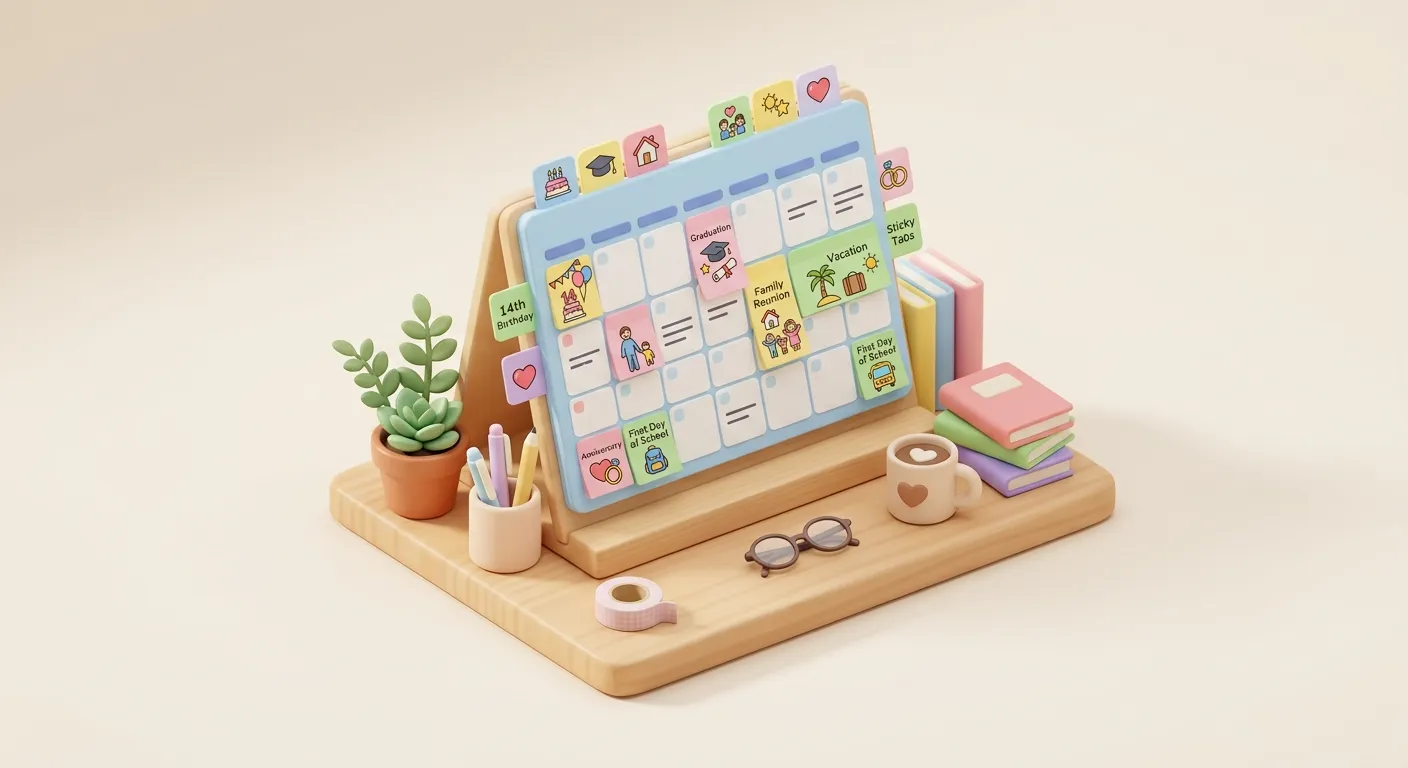
The Milestone Calendar: The Simple System Nobody Uses
This is the gap that most long-distance grandparenting advice never addresses, and it’s arguably the most important thing you can do.
Create a shared milestone calendar and give grandparents access to it.
Not a calendar full of every dentist appointment. A calendar of the moments that matter — the things grandparents would show up for if they lived nearby.
What goes on it:
- School plays and concerts
- Sports games (at least the important ones — playoffs, tournaments)
- Big tests and project due dates
- First days of school
- Report card days
- Birthdays (obviously) plus the week before
- Hobby milestones (the piano recital, the swim meet, the art show)
- Any “first” you can anticipate — first overnight, first solo bike ride, first day at a new school
The calendar does two things. First, it gives grandparents the chance to be proactive rather than reactive — to send a “thinking of you before your big game today” text rather than a “congrats on the win” message the next morning. Second, it removes the burden from you to remember to tell them. They can see it themselves.
Google Calendar, Apple Calendar, and Cozi (a family organizer app) all support shared calendars. For grandparents who aren’t tech-savvy, a monthly printed calendar slipped into the family newsletter works just as well.
Milestone-by-Milestone: What Actually Works
Not all milestones are created equal. A graduation needs a different approach than a lost tooth. Here’s a practical breakdown:
The Everyday Firsts (Lost Teeth, First Words, Small Wins)
These are the ones that slip through the cracks. They’re too small to plan around, but they add up to be the texture of childhood.
What works: A dedicated family group chat or text thread specifically for sharing these in real time. Not the group chat that also includes logistics and scheduling — a channel just for “look what just happened” moments. Keep it low-pressure: a photo and one sentence is plenty.
Some families use a simple voice memo. A 15-second clip of a five-year-old explaining why she lost her tooth, sent directly to grandma’s voicemail, is worth a thousand heart emojis.
School Events (Recitals, Plays, Games, Science Fairs)
These are plannable — and that means there’s no excuse for grandparents not to know they’re happening.
What works: Tell grandparents about the event at least a week in advance. This sounds obvious, but most families forget to do it because they’re deep in the logistics of attending the event and don’t think to loop in the people who can’t be there.
When the event allows it, set up a live video stream. Most smartphones can do this over FaceTime, and it costs nothing but a few minutes of setup. For performances where recording isn’t allowed, make sure someone films a recap directly to grandma after — not a full recording, just a minute of the child excited and talking about how it went.
After the event, send something physical. A program from the school play. A photo of the ribbon from the science fair. A brief note the child writes. These create a tangible record that grandparents can hold, show their friends, and keep on the fridge.
Big Academic Milestones (Graduations, Report Cards, Awards)
These deserve ceremony, even across the miles.
What works: Treat the grandparent’s role as a real one. Call them before you open the report card or tell them the grade — let them be there for the reveal, not just the outcome. Set up a video call for the “first look” together.
For graduations, consider whether a “gramping” trip — a special one-on-one trip between grandparent and grandchild — could be planned as part of the celebration. An increasing number of families use these skip-generation trips as milestone celebrations: the grandparent takes the grandchild somewhere special to mark the occasion. It doesn’t have to be expensive or far away. It’s the intentionality that counts.
Birthdays
Birthdays are the most predictable milestone of all, and somehow still the one that families most often handle awkwardly at a distance.
What works: The countdown approach. Instead of mailing one gift that arrives on or before the birthday, send a series of small things designed to build anticipation in the days before. A card on Monday, a small gift on Wednesday, the “real” present on the day. The child experiences several moments of being thought of — and grandparents get multiple occasions to feel connected to the celebration.
For older children and teens, consider matching experiences. Grandma books a movie she knows her grandchild is seeing on his birthday weekend — they watch it “together” and call to compare reactions. Small gestures, but they signal: I’m in this with you.
How to Make Grandparents Feel Like Witnesses, Not Recipients
There’s a meaningful difference between receiving news and being present for it. Most families focus on the first without thinking about the second.
Here’s one reframe that changes everything: tell grandparents about things before they happen, not just after.
A phone call the morning of the big game. A text the night before the recital saying “can’t sleep, she’s so nervous and excited.” A voice memo in the car on the way to the kindergarten orientation.
This is low effort. It takes two minutes. But it pulls grandparents into the emotional arc of the experience — the anticipation, not just the conclusion. When they call that evening to ask how it went, they’re not asking from the outside. They were already in it with you.
This is the thing that turns information into connection.
The “You Were There” Ritual
Here’s a family tradition worth starting: the “you were there” debrief.
After any significant milestone — a recital, a big game, a first day of school — carve out ten minutes for a video or phone call where the child tells the grandparent what happened. Not the parent summarizing. The child narrating.
It doesn’t have to be formal. “Hey grandma, tell grandma about the science fair” works fine. What matters is that the grandparent hears it in the child’s voice, in the child’s words, with whatever tangent and digression comes naturally. That’s the version grandparents hold onto. That’s the call they tell their friends about.
Over time, this becomes a ritual the children look forward to — and the grandparents plan their evenings around.
Building the Rhythm That Makes All of This Sustainable
None of this works if it depends on willpower and good intentions. It works when it becomes routine.
The families that do this well aren’t necessarily the ones most committed to connection. They’re the ones who’ve built simple systems that run on autopilot.
A few building blocks that help:
A monthly family update. Not a daily status report — a single monthly touchpoint that gives grandparents a narrative summary of the month. What happened, what the kids are working on, what’s coming up next month. When this lands in grandparents’ mailbox as a physical letter or printed newspaper, they read it differently than a text. They sit with it. They show it to people. A well-made family newsletter takes the pressure off of keeping grandparents updated in real time, because they know a full update is coming.
A standing weekly call. Not a check-in — a ritual. Same time, same day, with a light structure so it doesn’t devolve into a five-minute logistics call. This is where the small stuff gets shared. This is where grandparents feel current, not caught up.
The milestone calendar (described above) as the backbone. Everything else grows from knowing what’s coming.
For more ideas on building these rhythms, our guide to long-distance grandparenting covers the full toolkit of tools and habits that keep bonds strong across the miles.
A Note on Spring: The Season of Milestones
If you’re reading this in March, you’re about to enter the busiest milestone season of the school year. Spring brings school plays, spring sports, science fairs, class presentations, end-of-year performances, and for many families, graduations. Spring break arrives shortly, and with it the opportunity for deliberate family time.
More and more families are using spring break for what travel writers have started calling “gramping” — a vacation where grandparents take grandchildren somewhere, just the two (or three) of them, without parents along. It’s a beautiful tradition, and a perfect fit for a milestone moment: the trip marks the end of something (the school year) and the beginning of something (summer), with grandparent and grandchild at the center of it.
If that sounds appealing, spring break planning starts now. Even something modest — a long weekend at a lake house, a road trip to somewhere the child has always wanted to go, a few days at grandma’s where grandma is fully in charge of the schedule — creates the kind of memory that lasts.
The Hardest Part Is Simply Starting
Most families know they should do this better. They feel the gap. They make mental notes after every recital where grandparents only found out afterward, every birthday where the call felt rushed.
The gap doesn’t close on its own.
But it also doesn’t require a complete overhaul. It requires one thing: picking one practice from this list and doing it this week. Share the spring events calendar with your parents this weekend. Make a quick call the morning of the next school event. Set up a monthly newsletter that runs on its own.
Your parents want to be present for their grandchildren’s lives. They just need the door opened.
Hug Letters prints and mails a custom family newspaper to grandparents every month — a beautiful, tangible update that lands in their mailbox, keeps them in the loop between milestones, and gives them something to hold and share. It’s one of the easiest ways to make grandparents feel like real participants in family life, even across the miles.

About Martin Gouy
Martin is the founder of Hug Letters. Hug Letters is a family newsletter for grandparents. Every month, grandparents receive a heartwarming newspaper with photos and stories from the whole family.